April 14, 2013

Why Wash Wool (and Other Natural Fibers)


In a decadent, decaying mansion, laundry hang on clotheslines under an ornate chandelier. Is it decoration or necessity?

In an earlier post, I promised an explanation of how I wash my natural fibers. I am beginning to collect quite a few different pieces of 100% something or the other, only because I have overcome my fear of ruining those pieces in the wash- a fear which seems common to many people browsing the thrift store. This will not be an exhaustive tutorial of how to washing things- and if any of it is incorrect, please let me know before its too late. It's simply what has worked for me in the past.

If it is laundry day and the pile of clothing looms threateningly, do not- I repeat- do not just throw it all into the washer and run away. Different fabrics require different care depending on how they are created at a microscopic layer. Wool, for instance, is the hair of a sheep. And like our hair is comprised of tiny scales. When these strands are heated, the scales spring open and latch on to each other. If the fibers are then agitated, these newly formed teeth reach out and claw across each other, sticking and tangling- so when you pull your sweater out of the wash (which is designed to heat and agitate fabrics) it's the shape remains but about twenty sizes too small because of how the fibers compacted. Hence horror stories of ruined wool items.

But fear not- this need not be the fate of all garments.

An elegant, old-world style makes even a laundry room appealing.

First, look at the inside tag of each and ever item. These are put on by the makers who generally have a decent idea about how their item should be handled. If it says wash in cold, put in a cold pile. If warm, put in a warm pile.Never the two shall mix. It is surprising how many natural fibers can stand up to the washing machine- I have cashmere sweaters that like warm and cotton that likes hot.

If the tag says dry clean- it's a suggestion- not a commandment carved in stone.Put it to the side for the moment.

A Victorian Soap add where two women in white bend over a basin of water.

If the tag says dry clean ONLY- you're in a dilemma  The most common reason for this concern is that the item has a, generally, wool exterior and a silk or polyester lining. If you wash the wool in warm, it will shrink. If you wash the polyester in cold, it won't be washed. Dry cleaners- through magic I know not- are able to circumvent this problem. I've come up with three possible solutions:

~ If you have the money, want to ensure the life span of the piece, or just bought it from the thrift store, take it to the dry cleaners.

~ If you are a broke grad student like me and are ambivalent about necessary cleanliness or lifespan of the piece, put it in the pile with the other dry clean pieces.

~ If you are hard core, remove the lining from the item, wash each separately, and, I guess, resew them together afterwards.

Now, look to the much smaller pile of dry clean garments. What you need now is a bath tub, some mild detergent  and many, many, many towels. A spare room is also useful. Or understanding room mates.This technique is especially recommended for Grad students because the steps are far enough spaced that you can get a good chunk of studying finished between each.

An ordinary bathroom is transformed into a beautiful oasis through an abundance of house plants

First, fill up the bath tub with cold- it must be cold- water. Add a bit of detergent. Let the detergent soak in and then carefully add your sweaters and other things. If you are terribly conscientious, separate colors from whites from black. Fill the tub so that all the sweaters are submerged.

Do not scrub the sweaters.

Do not swish them about.

Do not mix them up, turn them over, attempt to reenact the parting of the red seat, etc.

Do squish them down lightly until they are submerged. Do gently press down on them- careful not to agitate the fibers. Do work any particularly dirty spots generally. (For actual stains, consult the internet.)

Let them soak in the water for as long as it takes you to memorize another chapter, then drain the water, fill the tub up again, and soak. This is the rinsing phase.


Once, you feel the detergent sufficiently rinsed, drain and leave the sweaters in there for a while. Press gently on them to remove some of the excess water, but let most of it drain out through gravity.

Here is where the towels come into play. After the sweaters are washed, rinsed, and drained, pick them up gently and, without squeezing, wringing or twisting, lay them flat on a towel. Yes, they will be heavy and soaked. Roll the towel up, squeeze out the excess water and transfer the sweater to another towel in another room. It will take about two days to dry fully (see what I said about understanding room mates) check twice a day to turn the sweater over and change out the towel underneath.

This would be an excellent time and place to put all those other clothes to dry. For, as you were reading the labels  you'll notice that about half of those clothes that can go into the dryer ask to be either line dried or dried flat. Listen to those requests! It is the hot air and the tumble drying that wear out clothes so fast. Plus, by air drying, you are saving electricity on your bill.


If a garment is knitted rather than woven, it will most likely be asked to be dried flat. If you try to dry it on a hanger, the garment is going to lose its form and you'll end up with awkward bumps on the top of the shoulder. Most unsightly.  Lay these out on a towel as well and they should be dried with in a day or two.

Those with tags that say tumble dry low, can be tumble dried low with just about everything else that is left over.

Now, you are still not quite finished. After everything has dried out, pick up your iron and ruin it quickly over your linens, cottons and any wool that are wrinkled. Pay attention to the tag not the iron settings. Another annoying thing about synthetic fibers is that you can't iron them without turning them into plastic. Natural fibers can be ironed and have that lovely, crisp quality. Then hang everything in the closet right away rather than keeping it piled on your floor. After all that work, it would be a shame not to put things away properly.

Do you see why washer women were so Vital to the Victorians?


Much like this post, laundry can seem enormously challenging. But it's not. All told, it is maybe three hours of work spread out over two days time. Getting up to change the laundry, turn over the sweaters or iron a few shirts is a great study break and can calm the mind while the hands remain busy. Plus, the next time that you put on your sweater, skirt, shirt or otherwise, you know that you are wearing something of great personal value.


If anyone has tips, tricks or questions, I'd love to hear them. Again, if it seems I am doing something wrong, let me know.

April 13, 2013

This Is Your Mood on Music

Painted by Michael Workman
For the past few weeks my mood swung towards the melancholy. Perhaps it is the change of seasons. Perhaps it is the grey skies and rain that mark the coming of summer. Perhaps it is just the natural swing of my moods.

http://media-cache-ak1.pinimg.com/originals/72/69/0e/72690e430e10b0871151ca578d3356f6.jpg

 I've noticed that a number of more atmospheric songs have infiltrated their way into my current, constant play list. Kafabindunya has beautiful, ethereal sounds - I recommend that you listen to them at least once- but they are long and melancholy. Listening to them I can transport myself to the lost wastelands of a post-apocalyptic world where the skies are every grey and the light is ever muted and the only living thing for miles is me. Reading, writing, accomplishing meaningful tasks seems beyond the scope of my energy.

As finals loom on the horizon, I have begun to play more classical music from a long instilled belief that the mathematical precision of bach can help me master all of physics. (It can't.) But in the past few days, my attention span has improved, I've crossed off several tasks on my to do list, and have been feeling more energetic and stable. Melancholia is relegated to those brief moments of contemplating the grey sky.

 In short, music not only effects my mood but my ability to function in the world. 

Now, I realize I am a highly sensitive introvert. Music, art, movies, really all media, affect me on a deeper level than they do for friends and family. It is only natural that my mood would be very affected by my sound track. Combined with  the seasonal changes and the weather, I became a perfect tuning fork for melancholia.

Melancholia is not a wrong or sinful state to be in. On the contrary  our obsession with remaining happy and stable is detrimental to our well being. Sadness, like pain, allows us to realize that there is something that makes us unhappy and needs to be fixed. It allows for greater introspection and empathy- two other characteristics sorely lacking from modern society. 

But melancholia without reason is harmful. Melancholia which lasts for too long is unhealthy. There are also times which are not conductive to being mournful and thoughtful- such as finals and tax season. Attempting to live forever in the state of feeling the worlds or your own anguish- much less basing your identity around such feelings- is frankly, counterproductive and idiotic. This is another problem I have with the Goth subculture as I understand it (please correct me if I'm wrong). "Memento Mori" (1) is vital but, as La Rouchfoucauld stated with his usual brevity "Le soleil ni la mort ne se peuvent regarder fixement." (2)


First, a Neo-Aristocrat knows his or herself. 

Second, a Neo-Aristocrat knows how to manipulate his or her moods to best fit the situation.

Faking or repressing emotions fails, but if you know yourself well enough to know what affects your moods, why listen to music which will make you less capable or functional? Better to wait until you have the space (and you should make the space) to be melancholy and then use the music to further your mood.


1. Remember that you will die
2. Neither the sun nor death can be looked upon fixedly. 

April 11, 2013

Why Wear Wool (and Other Natural Fibers)

Perched on the edge of a railing, a woman in a page boy's cap and long wool coat looks off camera. Her dress pattern of swirls like galaxies contrasts nicely

In an earlier post, I mentioned my desire to only buy and wear natural fabrics and promised a blog post of its own. Voila!

First a most basic overview:

Our clothing is made of fibers which can be divided into two categories: natural and man-made. Natural fibers (like wool, silk, cotton, linen, and hemp) are derived from animal or plant based products and are the fibers our ancestors have been spinning, weaving and wearing for centuries. Man-made products are a new invention- made within the last hundred and fifty years and are synthesized from petroleum by products and other chemically clever means (if anyone is interested in such a topic, I've probably learned enough Organic Chemistry to puzzle out the method.)

Now, there are some eco-friendly main made products synthesized from bamboo and other sustainable materials. As important as ecological consciousness is for a Neo-Aristocrat, fashion and budget are equally important. Most garments made from the trendy organic cotton or bamboo products are very minimalist and- in my opinion- aesthetically displeasing. Plus, you are unlikely to find them in a thrift store.


There are three reasons why I prefer natural fibers. The first comes from the benefits of wearing natural fibers. Due to various molecular and chemical formations, natural fibers last longer, are more breathable, contain some anti-microbial benefits and do not pill. May I repeat: they do not pill.

Most modern clothes are a mix of cotton and synthetic material designed to last maybe half a dozen times through the wash before ripping, tearing, falling apart, or creating those nasty little bundles of fiber that look and feel terrible to wear ie pills. At this point, the original wearer either tosses the shirt or, if moved by some desire to save the environment or help others, donates it to a thrift shop.  Quite frankly my dears, if you find the piece unwearable, your average thrift store shopper will too.

However, clothing of natural fibers is designed to hold up through many years of wearing and washing. Most of the clothing with a 100% natural fiber tag is still perfectly wearable by the time it reaches the thrift store. It looks and feels of a higher quality than most other items around it.

A beautiful, Victorian blouse featuring pintuck details, a high neck collar, and a lacy overshawl.

Which leads me to my second reason for loving natural fibers. They are more expensive to produce than man-made synthetics. Either plants must be cultivated or animals cared for- both which take much longer to grow than chemicals in a vat.

Generally, I've found that the more expensive the cloth the more innovative the design or, at least, the better quality the production. Higher end fabrics are marketed for higher end clothing- not discount or ridiculously cheap brands like what populate the modern malls of America. Higher end clothing tends to have the more interesting details and finishing that are absent from much of what I find in Forever 21. Better buttons, better seems, better zippers all result in a better product for you. (Of course, I realize that not all natural fiber pieces fit this stereotype, it is just the average of what I've found).

Finally, it is actually possible to find pieces like this. Due to trends in modern consumerism, much of the well made pieces are vintage or nearly so. At least, they don't fit exactly into the modern aesthetic. What? You don't care for a calf length wool skirt depicting an abstract french fishing village in muted blacks and greys? Well, by all means, it fits perfectly in my closet!

A Modern Red Riding Hood stands before the paparazzi in a beautiful red cape.

In short, yes, you do need to be a tad more discriminating. Yes, the pieces are harder to find. But it is worth it to have clothing that will be healthier for your body, last you longer, and be far more unique than what you can find in most modern stores. And with that: a new law of thrifting: buy for the fit and the aesthetic, not the fabric. Unless you are hungry for a new project.

I'll address maintenance concerns in a later post. Below are some links if you want to learn more about the health benefits of natural fibers- keep in mind the biases of most websites:

~ A lovely, basic overview of natural fibers

Everything you could possibly want to know about natural fibers and then some

A good graph to compare the relative strengths of different fibers

Why natural fibers are better in the landfill


April 10, 2013

Penniless Aristocrat: Public Transportaion

http://weirdvintage.tumblr.com/post/24911084140/in-1858-crinolines-had-to-be-hung-outside-public

Unfortunately, few of us have the funds for our own private chauffers or horse drawn carriages. While cars are a more common luxery, many of us Aristocrats in the penniless state look to public transportation for the main form of long distance travel.
However, the image associated with public transport is anything but glamorous- crowded, dirty, plastic, and depressing. It is hard to discredit those images. Nevertheless, one's surroundings do not define a person, but, rather, the other way around.

http://www.bl.uk/learning/images/victorian/newspapers/large103308.html

As someone who often rides the bus, here are a few little hints for making bus or metro riding as pleseant as possible:

~ Always have your fare or travel card prepped and ready. Nothing is more trying than standing behind someone who fumbles through their pocket for the last few coins. On that note, always carry enough change or extra charge on your person incase there is an emergancy.

~ Greet the driver when you board. Thank him or her as you exit. Try to make it as sincere as possible rather than routine.

~ Don't talk on the phone, to your friend, or to yourself too loudly. The bus is to be shared by everyone.

~ If you have larger bags, make sure they are out of the aisle way so people can pass.

~ Do offer someone your seat if they are elderly, look exhausted, pregnant, carrying heavy things, or have small children.

~ Here is the corrallary: If someone offers you their seat, accept gratefully even if you feel you can quite easily stand the rest of the way.

Why?

A good deed requires two parties: the doer and the reciever. Though the offering of a seat statisfies the urge of polite behavior, a good deed is not done unless the seat is taken. I, overly sensative to all social interactions, will actually feel worse for disturbing someone who does not accept the seat and wonder if I have accidentally offended them. Granted, most people you meet won't fret about this, but it is such a simple thing to thank them and accept the offer.  They can feel truely virtuous and you can rest your feet.

http://media-cache-is0.pinimg.com/originals/96/fe/ed/96feed6415212ace258d90ff8278cced.jpg

Are there any other tips for how to ride public transport elegantly?


April 9, 2013

How to Build your Winter Wardrobe


Winter has finally lifted her snowy hand from the ground. Birds sing in the trees, crocuses spring forth delicate and colorful, the weather turns practically balmy. As I prepare my cold weather clothing for storage,  I wanted to share an example of putting theory into practice. 


Spending the past four years in a warm and temperate climate did not prepare me for the chills and freezing weather of this Northern Clime. I had one sweater, one pair of winter socks and no long underwear or other layers to my name. When the first snow fell, my impulse was immediately to run to the nearest thrift store and buy as many sweaters as could fit into my arms as possible- regardless of size, material or color.


Such desperate measures do not become an Aristocratic Lady. How many times had purchases of desperation tided you over and then remained cluttering up your closet, never to be worn again? This was the perfect opportunity to practice designing a rational, aesthetically complete wardrobe. To purchase pieces I would love to wear, would match what already hung in my closet, and hold true to my aesthetic. But first, I needed to develop that aesthetic.


My first stop was to various blogs, tumblrs, cold weather adds and more. I skimmed through hundreds of pictures, sending any photo that even remotely caught my eye or my interest to a Winter Wardrobe file. After a week, a sizable collection had developed. This time, I flicked through those collected  photos and took stock of any themes in the photos. While a fur skirt is out of the question, alas, there was a noticeable trend towards fair isle designed, oversize sweaters, and many layers.  


But, in the course of my wandering through various books, I just finished "Overdressed: the surprisingly high cost of cheap fashion" by Elizabeth L Cline- an easy, informative overview of what is wrong with the modern garment industry. It was this book, however, that cemented my desire to only buy and wear natural fibers- but that is a blog post of it's own.


My final consideration was the realization that I disliked cardigans. No matter how good they look on the web or hanger, no matter how classy they seem, I feel frumpy when I wear them. Short, long, thin, thick, belted, not- I feel as though I've gained twenty pounds and fifty years with a single garment. No matter the price, fabric, or design- I was not going to add another item to my closet that would make me feel awful by the end of the day.


Armed now with a set of themes, the axiom of only 100% natural fibers and the resolve of no more cardigans, I finally ventured into the thrift store. What could have been an overwhelming selection, was now manageable  I passed over the solid colored sweaters and went straight to the patterned- flipping past the cardigans until I found 100% wool sweaters.


Now, three beautiful, adored sweaters are sitting on their shelf, ready to be packed away for the summer. They will keep me warm and elegant feeling for years. Plus I'll have the satisfaction of knowing that they are a result of not random chance, but careful consideration and planning. I am planning on doing the same with my summer wardrobe soon after the success of updating my winter one. I hope that you found this case study interesting and possibly helpful. There are so many fashion blogs and magazines, but so few that actually give a solid example of how to turn your aesthetic into reality. 

Has anyone had similar success with their wardrobes or have a different method for choosing clothes?

April 8, 2013

Seven Lessons in Elegance: April


Elegance is the hallmark of an Aristocrat. It pervades every movement, every word, ever gesture. But in the hustle of our day to day lives it is easy to forget that we must have elegance in the little things as well as the large. So this is the first of a new series of monthly reminders: little habits to be aware of to make sure we remain elegant every day.

1. Take your seat elegantly. Do not fall, slouch or plop, but  sit with controlled grace.

2. As you walk, sit, or stand, try to raise the sternum of the chest for better posture. Do not throw your you shoulders back, but raise your spine. This improves breathing and circulation as well.

3. Turn off your computer at the end of each day. Do not leave it asleep, by the edge of the bed, but finish the day  completely.

4. Tidy your desk or work space before bed. Some chaos is necessary in the room and soul of any Aristocrat, but a cluttered desk only wearies the mind before the day's begun.

5.  Arranging your hangers evenly, despite the futility of the task, makes for a pleasing display in the closet. Measure one fingers width between hangers.

6.  Go through your unmatched socks and try to find their pairs. If they remain lonely at the end of the process, throw them away. Why clutter your life?

7.  Try to smile at people as you pass them on the street. Take note of who smiles back and who doesn't. It is a little ritual to bring a sense of community to our modern world.

Seven simple tasks. Seven little reminders. Rebellion and alternative lifestyle are found less in ones thoughts and more in the simple acts of day to day life.

What do you do to bring elegance to your life in little ways?

March 3, 2013

Evolution of Aesthetic: Knowledge

From: Art's The Answer!
Stagnation is the surest path to death, either of our minds or our spirits. To nurture our intellect, we must continue to consider new ideas from books read or discussions had. However, nurturing our aesthetic can take many roads. The most accessible way is  a regular attendance of new galleries or exhibits to keep the flame of creativity and inspiration burning. It may just be my love of books, but I find the more I learn about the world, the more beautiful it becomes.

St. John the Baptist, Jusepe de Ribera c. 1624
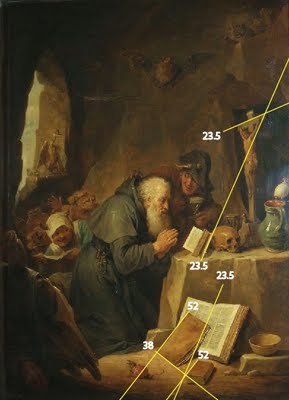
Usually, paintings such as the two found above bore me completely. Being neither religious nor a historian of art, these don't speak to me in the slightest. However, after reading Theresa Cheek's excellent post on the excessive use of the angle 23.5 degrees, these religious pictures became more interesting. (I  highly recommend reading the original post and her blog Art's The Answer!: 23.5)

From Science Blogs, Starts with a BANG
The earth is titled at a 23.5 degree angle from a perpendicular access to the ecliptic. The Ecliptic is the perceived path that the sun and the planets follow through the earths sky. In the Ptolemaic days, people thought that it was the sun's path that was tilted in regards to the earth, but later Astronomy proved that it was the earth that was tilted instead. This tilt is responsible for the different seasons of the year.


As Ms. Cheek illustrates, early painters were well aware of this angle and considered it divine. They hid this angle in a number of different places in their paintings- from the subtle as in the picture above to the more obvious pointing of the arms in the early pictures. These paintings are full of mathematical and astronomical symbolism which makes them far more interesting than I ever gave them credit for. Read her article or look up some more examples to see for yourself.

I still don't care for these early paintings, but after learning how to see the angle of the ecliptic they are more palatable than before. My aesthetic has increased slightly from this knowledge.

If this interested you, look at Paradigmshift for tons more examples.

What have you done to evolve your aesthetic?