Showing posts with label An Aristocrat in the Kitchen. Show all posts

July 23, 2013

Aristocrat in the Kitchen: Cookies from a Wood Burning Stove

Over the weekend, I had a fun adventure with a recipe from another century. The Country Handmaiden, who does reenactments on the weekends, baked these cookies first and posted them on her website. (Yes, as all-but-an-atheist, I do enjoy reading Christian Homemaking blogs. But the importance of being regularly exposed to ideas with which you disagree must wait for a later post.)

The recipe is as follows (emphasis mine):

Ginger Snaps (1890)

2 eggs well beaten
1 cup brown sugar
1 cup molasses
1 tsp ginger
1 tsp soda
Enough flour

Mix in order given.  Turn out on a floured surface; cut into shapes.  Bake in a quick oven.

Luckily, Miss Elizabeth does a quick bit of translating to make the recipe more recognizable for us who are used to modern cookbooks where all the steps and ingredients are given.  I like ginger snaps, I had a jar of molasses in my pantry, I thought it would be fun to make an old fashioned cookie, so I gave it a go.

Now a word about molasses: it is amazing. Sweet, but also a hint savory, it is one of the better sweeteners you can use by taste. But it also has amazing mineral properties giving you an excellent source of manganese, copper, calcium, iron, potassium and magnesium. Your body depends on these minerals for a wide variety of biochemical reactions, but our diets and our food these days don't provide much by way of minerals. So unless you are taking a multivitamin- which you should be- you could be mineral deficient. (Obviously, don't take my word for it. Do you own research or consult with your nutritionist.) 

Full of excitement and delight, I mix up the ingredients and begin adding flour. Now, maybe it was the heat (edging into the 100's that day) or maybe I just miscalculated something, but I added A LOT of flour before the dough wouldn't stick to the counter as I tried to roll it out. The cookies came out of the oven (after only 7 minutes) rather puffy and cakey.

The cookies were less of ginger snaps and more of travel rations. Thick, heavy - not bad tasting- but not like any cookie I've had before. You could eat two for a meal and be just about fine.  Now, I'm not sure if it was my fault for adding too much flour and being incapable of rolling out cookie dough, or if cookies have evolved since the 19th century. Maybe they were heartier and less delicate now. Fewer dainty macaroons that you see popping up everywhere and more of the breakfast cookie you can buy in coffee shops. It was a fun experience, even if I'll be sending most of them to my boyo.

Have you ever experimented with recipes from another era or century?

July 11, 2013

A Parable of Nutriton

A cornucopia of all sorts of food.
What thanksgiving feasts probably should consist of.

Once upon a time there was a young girl who wanted to be healthy. She knew that the first step towards a healthy life was a healthy diet so she went to her local food guru and asked what to do. The guru listened to her diet, which was typical of a college student, and told her "Eat more fruits and vegetables." So, she stocked up on apples and lettuce and bananas and all was good.

A little while later, she went back to the food guru and said "Alright, I am eating fruits and vegetables with every meal. Will I be healthy?" The food guru shook his head. "No, my child." he said. "For you are eating foods sprayed with deadly chemicals. You must eat organic foods to be safe." So the girl threw out the typical food and stocked up on organic fruits and vegetables. For added measure, she began only eating organic bread, cookies, icecream and snacks too.

Having eaten more plants than a rabbit, she returned to the food guru and said: "Alright, my house is totally organic. I buy organic dishwasher, organic salsa, organic cookies- everything is 100% organic. Will I be healthy?" The food guru shook his head. "No my child," he said, "Even though those food are organic, they are still processed and full of chemicals and other contaminants from factories.  Eat close to the food source. As raw and natural as possible." So she went back and threw out all her peanut butter, processed foods, frozen organic pizza's and bought natural.

After eating like this, she went back to the food guru and said "I'm eating organic, natural ingredients. I cook with only whole foods. I make my own pizza and cookies from only the most natural of products. Will I be healthy?" The food guru shook his head. "Not yet, my child." he said. "For you are eating foods that were grown in far off fields on factory farms- organic or not. The shipping pollutes the air and destroys the nutrient value of the food. No, you must eat local food grown in the surrounding area." So the girl looked up farmers markets, local farms and began buying as close to her home as possible. She was lucky she lived in an area that had such access to farms all around.

After restocking her house, she went back to the food guru and said "I am friends with my local farmers, I know the name of the turkey I will eat for thanks giving, I am a regular member of the farmers market. I'm learning to eat in the seasons. Will I be healthy now?" But the food guru shook his head. "Not yet, my child." He said. "Food today is far less nutritious than food was fifty years ago. The soil is depleted. Even local organic food doesn't offer the same nutritional value as it should for the stressful life you lead. You must take supplements." And so the girl went home, researched vitamins and supplements and developed a complicated but thorough plan to stay healthy.

After taking 11 different pills and supplements that morning, the girl marched back to the food guru and proclaimed. "I eat fruits and vegetables from local, organic farms. I make all my food myself. I have a complicated number of pills and tablets to take each week." She brandished the schedule she made for herself. "Most of my time is spent either buying, preparing or cooking food. Am I healthy yet?" The food guru leaned forward, looked over her schedule and menu plan, and then shook his head.

"What!" exclaimed the girl. "What else could their possibly be?"

"Your diet is too regular," said the food guru. "Food insensitivity springs from too much of the same food. You must vary your ingredient intake or risk developing an insensitivity."

"Ok," said the girl. "But if I do that, will I be healthy?" The food guru shook his head.

"Oh no. Because you are also eating too regularity.  You must have time to fast and let your body purge itself of accumulated toxins and build up. And after that you must start considering food that is good for your blood type, that is not too acidic, that has the right thermal temperatures. You must investigate whether it is a paleo diet or a vegan one that is best for you. You must keep up to date on the new algeas and seaweeds that will prevent cancer. You must be soaking your grain before eating it. You should be milling your flour, growing your own food, foraging for your own food in the wilderness-"

But as the list of eating requirements grew, disgust and despair filled the girl's heart. She had done so much and it was all for naught. Shaking her head, she left the food guru's sanctuary, went to a fast food chain and ordered one of everything on the menu.

Moral of the story:

There will ALWAYS be something more to do to improve your diet. You will never reach the most perfect, healthiest diet no matter how many books you read, seminars you attend, and nutritionists you visit. There is just too much we don't understand about the digestive system and too much conflicting and directly contradicting data in the world.

But just because perfection is unobtainable, does not mean we should give up like the girl and regress back to fast food. Each step we take along the path to perfect eating does help, does improve our lives and health, does help the planet a small bit even if we acknowledge it is not the panacea.

What do you eat to be healthy?

June 7, 2013

The Health of Aristocrat: General Principles

Steel engraving of the 1851 Great Exhibition, Crystal Palace Credit: Wellcome Library, London
Steel engraving of the 1851 Great Exhibition, Crystal Palace Credit: Wellcome Library, London

I'll admit, these past few days I have been stumped on how to proceed with blogging about my new goal of living a healthier life. There is so much information out there in the Western canon alone about proper exercise, nutrition, habits, sleep and stress. Much of it contradicts. Much of it applies to only a certain subset of people. Add the eastern medical training I'm receiving and the entire mess simply becomes more complicated.

Rather than attempt to act like the expert I most certainly am not and bring you pearls of healthy wisdom, I'll just mention some of the things I am thinking and doing in my life coupled with a little of what I am learning at school. These will skimp (read forget) much data or scientific references. How does that phrase go? These blog posts are not intended to diagnose, treat, cure or prevent any affliction or disease. Please see your health care provider for any questions or concerns.

Whew. Getting into the habit of navigating this bureaucracy riddled world of healthcare already.

Here are just a few of the general principles I've come to associate with general health issues. At some point, I may take a post and expand on them, but here they are never the less.

~ For medicine, less is more: Doctors and other health care providers are just people- despite what they may want to think. If you pay however much for a health care visit, there is pressure to prove that it was money well spent and doctors might over diagnose. Also, the general problems of mistakes in the hospital, misdiagnosed pills and medications, and unintended side effects. In general, go for the least invasive care. Nutritionist over pharmacy. Massage over surgery.

~ Variety is the spice of life: Eating too much of the same food can lead to food sensitivity. Exercising in the same way everyday can lead to decreased benefits and damage elsewhere in the body. Since we were made to consume, process, and think in such a varied menagerie of ways, we should do so.

~ Eat food as close to harvesting it yourself as possible:  Minimally processed food is better than more processed food. Fresh food is better than frozen or canned food. Local, organic food is better than the food in your grocery stores. And if you can have a little garden and pick the salad greens you will have for dinner that night yourself? That is even better.

~ Live an active life rather than go to the gym: It really doesn't make sense to me when I see people take an elevator to go to their stair steppers. I realize the appeal of having your metrics flashed before you and being able to chart your progress. But it seems like such a fragile system compared to just making sure you get up and move more each day. Take stairs, rather than the elevator. Do curls with your groceries. Get up and move around the house rather than stay locked to your computer (this one I really, really need to work on)

~ Have a morning routine: Have a morning routine. I don't think it matters if it is push ups, yoga, tai chi, or just stretching. But some sort of daily practice is essential really good to get your body moving again after a night's sleep.

~ Sleep: For something so simple and obvious. It is really sad how little we get.

~ Get outside: Whether it is to be in the sun (very important), to realign your magnetic field with the earth's, to go forest bathing, calm your mind and relax your body. Being outside is essential. We are not made to be locked away in houses and airconditioned rooms.

~ Reduce Stress: The most obvious and most difficult of the principles I think.

Those are some of the health principles I try to live by. The simpler the principle and the more complex and varried its applications, the more truthful it is I think. Do you have any health principles you live with or by?

May 2, 2013

Aristocrat in the Kitchen: Layering Food

A Victorian girl sits for breakfast in a lush room.
Annie Rose Laing (nee Low) "At the Breakfast Table"

On Saturday I mashed sweet potatoes.
That night for dinner, I had an artichoke and a bowl of mashed sweet potatoes.
On Sunday, I chopped up a tomato, avocado and sweet onion salsa
That night for dinner, I had a small bowl of sweet potatoes and toast with salsa.
On Monday, I made strawberry jam from discounted strawberries at the store.
That night for dinner, I had a small bowl of sweet potatoes, a slice of bread with salsa, and a slice of toast with jame for desert.
Yesterday. I chiffonade and roasted Brussels sprouts
That night for dinner, I had a small bowl of sweet potatoes, a slice of bread with salsa, and a small side of Brussels sprouts.
Today, I made leek and bacon white sauce.
This night for dinner, I had a small bowl of sweet potatoes, a slice of bread with salsa, a small side dish of brussel sprouts and a few bites of the leek and bacon white sauce.

A girl sits in a court yard filled with hay and broken baskets, plucking a chidken
William Henry Hunt "Plucking the Fowl"

This is not my attempt to try and rewrite "The 12 Days of Christmas" with much less entertaining or rhythmic verses, but rather me trying to put a theory into practice.

Often, as is the course of most grad students I've met, I will work right up to the point past hunger, run down to my refrigerator and throw it open only to realize I have nothing to eat. Oh, there is food there, but it all takes at least thirty minutes of preparation. In sadness, I stuff myself on popcorn.

Or, I only have enough time to make one item of food which leaves me hungry and lacking many nutrients.

All in all, it shouldn't have taken me very long to come up with my new idea of layering food. The concept is very simple:

Every night make one largish batch of something new. For dinner, eat a little of that and a little bit of all your other food for a more balanced meal.

In short: continual leftovers.

A medieval cook glances disdainfully over her shoulder as she prepares chickens for the spit
Pieter Aertsen "A Cook with Poultry"

This is working for me for several reasons:

~ Cooking is mostly scalable. Cooking five sweet potatoes to mash doesn't take a considerable amount of more effort or time than cooking one.

~ Cooking only one dish a night is incredibly freeing. Rather than needing to plan a new menu every night and cook up a protein  vegetable, and starch. I can just cook one thing and add it to the repertoire.

~ There is a greater variety of food in my fridge. When you only eat a little of a dish, it lasts for longer than when you consume half of it as your whole meal. (Though, I do admit I am learning the downside of this with the sweet potato)

~ I know I am getting a better variety of nutrients, flavors and vitamins with each meal. I've heard that the body isn't full until you've had one of every flavor. This ensures you don't have to break your back doing that.

~ If I run out of time and skip making a meal one day, I'm not going to resort to junk food. There is enough food in the fridge to tide me over for a day or two until I can cook some more.

It is this final point that appeals the most. For the sake of my pride, I'm not going to mention how many dinners were little more than popcorn or chips, just because I was too hungry to cook by the time I went down to the kitchen. Now, even on the days I'm stressed or distracted, I won't be skipping a nutritious meal.

It's not exactly an anti-fragile. However, it is far less fragile a system than before.

April 23, 2013

Aristocrat in the Kitchen: Learning to Cook

A yellow kitchen in an old castle.
Despite the old walls, the kitchen still feels welcoming.

It is a sad fact of life that not all of us are born knowing how to cook. It is even sadder that reading through cook books, food blogs, or nutrition text books does not grant you the ability either. Oh, it is possible to slough through a cook book, following each recipe exactly, and emerge with some idea of how to cook. But it won't be that enviable competency of the kitchen.

The sort where, upon strolling into the grocery store and seeing tomatoes are on sale, immediately inventories their fridge and buys half a dozen knowing how to create salsas, pizza sauces and the like as soon as they return home. It isn't the sort who has rack upon rack of spices and tosses them into the soup seemingly at random- stopping only taste the broth, nod sagely to themselves and then a few more sprinkles of this and that and- Voila! Perfection in a bowl.

Luckily, if cook books lead to half knowledge and experimentation leads to unedible or bland constructions- in my experience- there is a very simple way to learn how to cook: ask a friend. Learning from another person is far more enjoyable than the other ways and, I believe, is far more instructive. Unlike a cook book, a friend can answer your specific questions or explain how to do some incomprehensible step. The process is very simple:

A gothic kitchen: the wall behind the stove is a decadent carved tile. Worth of a castle.
A dream stove.

1. Find a friend who is willing to teach you to cook. No doubt there is always someone who possess more knowledge in the kitchen than you. Be it your best friend or someone you would like to be better friends with, ask them. People like doing other people favors.

2. Choose a menu. Depending on your skill level, it is better to start with simple basics that you can make on a weekly basis without going over budget growing sick of. Pizza dough and pizza, roasted root vegetables, pasta sauce, home made soup, fruit tart, etc.

3. Go shopping. Everyone has their own route through the grocery store and their own small list of things to buy. Going shopping with a friend is like stepping into an entirely new building. Aisles you never traveled down before suddenly become full of new, exciting products. Plus sales or certain items might spark last minute menu revisions. An elegant touch is to offer to pay for all the groceries. After all, you're the student.

4. Cook! You may end up doing a lot of things you've done before- like chopping garlic or washing lettuce. But that's alright. Watch your friend carefully. Ask questions or for clarification. Pay attention to what spices or sauces are used. Play some nice music. Have a good conversation in the down time. Learn to clean as you cook.

5. Eat the food you prepared. Most cooks will have a commentary about what they have just made. The butter didn't cool enough. The chicken wasn't cut into small enough pieces. It could have used some more garlic salt. Listen to that and memorize the taste of the food. You are beginning to develop a palette for different dishes. Soon, possibly, you'll be able to deconstruct dishes at restaurants.

6. Make the food again. Within the next week, make each of the dishes you learned again. They won't be exactly the same. They won't taste quite as good. But you need to memorize how to make them and start learning to tell yourself that "Oh, this needs more salt" or "That was over cooked." This is also a good time to realize that you didn't remember how hot to have the oven or that you weren't paying close enough attention to the spices. Look it up online or call your friend.

7. Go back to the cook books. Now that you know the basics of how to roast a sweet potato or make a pizza, go to the cook books or online for inspiration and variation. Tastespotting is one of my favorite cooking sites. As you grow more comfortable with the foods, feel free to start improvising with ingredients or techniques. The more you learn, the more confident you'll be in the kitchen and the better your diet will become.

How did you learn to cook?


April 15, 2013

Aristocrat in the Kitchen: Plate Size

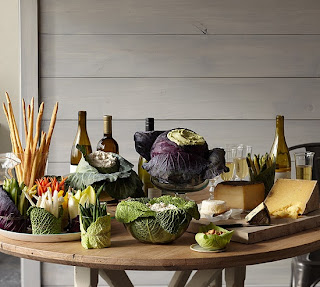
A heavily laden Thanksgiving table where the serving dishes are vegetables and all the food is natural.
From November 2011 of Martha Stewart Living

Food is one of the most important and most complicated things we do to our bodies. Passion  lifestyle, memories, and health all center around your diet and yet there is so much confusing and conflicting information about what to eat and what is healthy to eat. Untangling those problems is a series of posts for another day.

What I want to talk about today is plate size.

I have a confession: despite my schooling, intentions, and better knowledge, I don't eat until I feel full or, better yet, until I'm not hungry. I eat until my plate is empty. As with everything, there are several reasons: I eat at my desk while studying, I don't pay enough attention, I put off hunger until my blood sugar drops, I am loath to throw food away, etc. Many of you probably have similar problems.

However, as we all know, over eating is a huge problem in America and the developed world. The body is overwhelmed by the calories, the processed sugars and carbs, the sheer glut of food- and becomes sluggish and unresponsive. I lack the self discipline to leave that last half of toast on the plate or those last four bites of pasta in the bowl. If I try to impose such discipline on myself, then the struggle exhausts my will power and I end up caving in somewhere else. Studies show this is a common phenomenon.

Pretty Pink Lolita dining ware, perfect for a spring tea.
Found on Haute Design by Sarah Klassen

This is all to explain why I am so happy with my latest discovery in the realm of life hacks: little plates and bowls.

There are two principles I am working from:

First, the human body is designed for feast and famine situations. It wants to over eat because it lives in constant fear that this will be the last meal ever, despite seeing the full fridge and cupboards every day. Unfortunately, there is not much we can do to overwrite this biological predisposition. Will power only gets you so far.

Second, the reversal of the shopping cart phenomena. Stores use huge shopping carts to encourage shoppers to buy more. After all, the contents of your grocery list look pitiful in the expanse of empty wire. Why not add a few chips?

Nine bowls, each filled with a different dish, that are served along with Korean dinners. Goodness in small quantities.
Korean Banchan

My room mates have in addition to their normal plates and bowls, a set of salad and small soup bowls that hold about a cup of soup. For the past week, I've been trying to exclusively eat with these smaller dinner ware and these are my results:

~ One cup of soup- the recommended portion size on the side of the box- looks pathetic and sad in a regular bowl. In a small one, it looks like a full meal. A single scoop of vegetables or pasta seems dwarfed by the vastness of a regular plate. On a salad plate, it looks overflowing. By restricting the size, I've simulated over abundance and satisfy my bodies worry of not having enough.

~ I am not hungry.  Despite reducing my portions by sometimes up to 50%, I don't feel hungry at the end of the meal. I remain satisfied until the next meal. It might be the visual cue of an empty plate which sets off my

~ There are more meals in my fridge. Because I'm still cooking the same amount but eating much less, I can usually squeeze another serving from the food prepared. A lucky find for grad students on a budget!

~ I pay more attention to what I'm eating- this could just be the  novelty of using smaller dinner ware and will fade as I acclimate, but I enjoy having a bowl I can hold in the palm of my hand. Which means that-

~  I usually eat slower, chew more and enjoy the food more. All essential proponents of better digestion.

~ I feel better. Both physically for eating better and less and psychically for being virtuous and dainty by using smaller portions.

~ There's more room in the dishwasher. A very small point, but it makes me happy to increase the space between unloading.

Beautifully detailed, textured Iranian plates
Beautiful Iranian plates

 I'd like to add an addendum to a rule mentioned in an earlier post:

A Neo-Aristocrat knows how to manipulate his or her environment to best suit his or her well being.

Rather than worry about weight gain, struggle with ingrained habits, and feel bad about my lack of discipline  I manipulated the world and did away with the problems. If you want to do the same, here are some tips:

~ Go to the thrift store and purchase a small plate and small bowl. Salad size or smaller. It shouldn't cost more than a few dollars. Naturally, don't buy doll size plates. Choose something that will reduce your food intake without taking you to the opposite extreme of anorexia.

~ If you can't afford that at the moment- believe me I understand- try just putting less food on your plate. It doesn't have quite the same effect, since the food looks so soft and pitiful and I feel like I'm not eating enough, but it make work for now.

~ Make sure you do the same technique for your other snacks. Don't bring a bag of chips to the desk- bring a small bowl. Try buying smaller fruit to eat. Make sure that there is a definite limit to your food.

Are there any other tips for portion control that you have?